

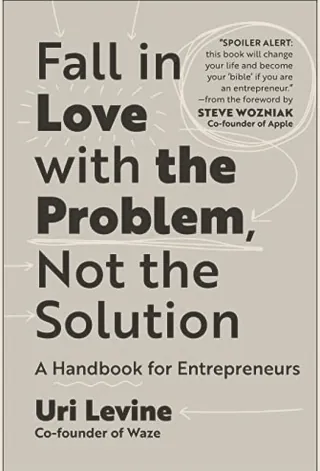
- Building a start up is a roller coaster journey with ups and downs. Fund raising is a roller coaster ride in the dark- you don’t know what’s coming.
- In a start up world, there are right decisions and NO decisions, that’s the world.
- The never ending phases of a start up are people, funding, investors and users.
- Building a start up is like falling in love, there are many ideas you can pursue, eventually you pick one.
- Starting a company is a leap of faith. If you are not willing to give up your salary, position and title, then you’re not deeply in love.
- The Qualification Matrix
- Niche Winners
- Losers Dreams and Nightmares
- Few Users Many users on x-axis
- Low usage / Value on y-axis
- Your passion for making a change must be greater than your fear of failure and the alternative cost.
- The strongest form of passion is not for methods of making money but to make the world a better place.
- Failure is not only ok but necessary. It maybe the most important thing to understand about building a start up.
- What matters most is how fast you recover – how quickly you can get back on your feet after failure.
- Four things for better product market fit
- Fail fast so you have more time /runway for more experiments
- Listen to your users
- Focus on the problem
- Make the hard decisions if needed
- Failure is an event, not a person.
- If you try new things you will fail, you must celebrate small wins and must always ask the question – ‘what have we learnt from it”
- What is disruption? Changing market Equilibrium!
- Market equilibrium =
- product
- price
- model
- knowledge
- Disruptors are always newcomers. Traditional Organizations can never disrupt from within. Entrepreneurs are trouble makers in most cases.
- Markets that have missing information needs are simply crying for disruption.
- Why can’t existing companies change?
- DNA
- Lack of Entrepreneurs
- Ego
- All entrepreneurs have what I call “the all over phase where they are trying or doing too many things”. Stick to phases and operate by them.
- Being a unicorn needs the stars to be aligned
- Product market fit
- Large market
- coolness
- User growth and globalisation worked out
- Life time value is high
- Frequency of use is key in consumer markets. If you don’t get a retention of 30 % in 3 months, then its not working.
- Investors only invest when they like the CEO and the narrative.
- Key investor indicators
- If they speak about the deal, they are interested
- If they ask who else is interested in the deal, they are interested
- If they ask who the previous investors were and want to see your cap table
- If they offer advice on how you can change your presentation for better impact
- The best way to manage existing investors is to keep them informed. Ask existing investors for help in areas they can help in.
- Raising money always comes with bad timing. It normally takes six to 12 months to get the right money at the table.
- If you need funding you need to have charts that show
- you are always growing
- are growing better than industry
- show your beauty and
- show progress over time
- Managing a board means always telling the truth. This means reporting facts as facts and hopes and thoughts as such.
- In every start up/company you will have
- 2 % amazing employees
- 15 % excellent employees
- 33 % good employees
- 33 % mediocre employees
- 17 % who shouldn’t be there.
- Firing is critical and doing so fast is even more important. If you have doubt on who to fire, ask the people in your organization, they will tell you.
- Most companies hire too early. The best way to hire is of you can see what the new hire will do for the next 90 days.
- Hiring a CEO
- Someone who never gives up
- Someone the team will follow
- Someone who listens to the customers
- Someone who is not afraid to take the hard decisions
- Someone who can build strong teams
- Someone who reports accurately and is not a BS er
- No one reads anything - not manuals, not messages, not app blurbs.
- Product market fit is only about conversion of first time users from being non users and then retention, i.e. number who keep repeating.
- The sequence for product market fit is....
- Total addressable market..
- Download..
- Registered..
- used once..
- got value..
- Retained
- Users normally have the following route
- understanding what your app or service does
- getting to the value
- deciding if there is enough value in it.
- Creating value needs
- a business model story
- a formula.. (Life time value minus cost of goods sold) / customer acquisition cost
- Time
- Most B2B models revolve around
- our product helps you save money and/or
- our product helps you make money.
- Price is determined by the market, cost is determined by the company and the market doesn’t care about it, if your cost is high its your problem.
- Word of mouth is the holy grail. Word of mouth is an outcome of high frequency of use.
- The top 5 markets for global expansion are nearly the same or a combination of:
- USA
- India
- Brazil
- UK
- Mexico
- Indonesia
- France
- Vietnam
- Russia
- If you go global, choose a significant market that’s easy to win.
- You should do an IPO if ...
- you think you have something really big
- you don’t see anyone acquiring your company
- you have raised a lot of money at high valuation
- When you sell out, the most important things to think about are
- You
- Your team
- today and tomorrow
←The bookcase
One of the books Shaun rated five out of five.